Why did Yunmen answer only with "Mount Sumeru"? The aim is to break away from everyday gossip-like routines trapped in conventional answers and value oppositions created by society, and for each individual to reclaim an unshakeable autonomy.
From Shoyoroku, Case 19: Yunmen’s ‘Mount Sumeru Kanbun reading method of Classical Chinese
To cite:
A monk asked Yunmen,
A monk: Is there any fault even when no single thought arises?[Your words are clean, but your action does not match them]
Yunmen: Mount Sumeru.[How steep and high it is]
From Shoyoroku, Case 19: Yunmen’s ‘Mount Sumeru Modern Meaning
Glossary: What are the Buddhist and Zen terms used in this article?
須弥山 (須彌山, Shumisen, Mount Sumeru)
The world view of ancient India. It is a concept equivalent to the solar system as we think of it today or the former geocentric model. In ancient India, people believed that Mount Sumeru was the center of the world. In Sanskrit, it is called Sumeru. It is also called, 須彌樓, 修迷樓, 蘇迷廬, 妙高山, 妙光山, 安明山, 善積山.
Features of Mount Sumeru
Position and Scale: It stands on the golden wheel at the center of a world, and both its height from the water surface and its width are 80,000 yojanas.
Materials of the Four Sides: The east is 黄金 (gold), the south is 頗梨 (sphatika, crystal), the west is 白銀 (silver), and the north is 瑠璃 (lapis lazuli).
Surrounding Environment: It is surrounded on all four sides by香水海 (the fragrant ocean) and 七金山 (the seven golden mountains).
The Four Continents and Human Habitation:
Around the four sides of the seven golden mountains are the four continents: 東勝身洲, 西牛貨洲, 南瞻部洲, 北倶盧洲.
南瞻部洲 (南閻浮提) refers to the Earth where we live.
Outer Edges of the World and Geocentric Features:
Around the four continents is 大鹹水海 (the great salty ocean), outside of which is 鐵圍山 (the Iron Encircling Mountain). Furthermore, 地輪 (the earth wheel), 金輪 (gold wheel), 水輪 (water wheel), and 風輪 (wind wheel) surround this, and outside of that is 大虚空 (the great empty space).
Since the sun and moon are located on the halfway slope of Mount Sumeru and revolve around the four continents, it can be seen as a kind of geocentric model.
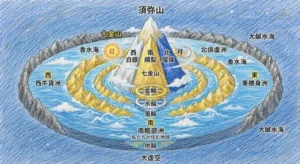
An image of the Buddhist worldview centered on Mount Sumeru
差別 (Shabetsu, differentiation)
差別 (Shabetsu, differentiation) and 無差別 (Mushabetsu, non-differentiation) are Buddhist terms. They do not mean superiority, inferiority, or unfair treatment like modern social human rights issues. Instead, they mean whether there are individual distinctions or not.
二見対待 (Niken-taidai, Dualistic Opposition)
A perspective that views things by dividing them into two opposing categories, such as “right or wrong.”
What are the characters in Yunmen’s ‘Mount Sumeru?: Yunmen Wenyan and a monk
Key Point: The characters are Zen Master Yunmen Wenyan, who cuts off the other person’s attachment with a sharp word, and a monk who asks about the rights and wrongs of no-thought and no-mind.
The characters are 雲門文偃 (Yunmen Wenyan) and a monk.
Who was Yunmen Wenyan?: A brainy Zen master who delivers a sharp, single word
He was from Jiaxing, Zhejiang province (currently Jiaxing City, Zhejiang Province), and his secular family name was Zhang.
He studied under 睦州道蹤 (陳尊宿, Muzhou Daozong, Chen Zunsu) in Muzhou and clarified the great meaning of Zen.
He became a dharma heir of 雪峯義存 (Xuefeng Yicun).
He succeeded 霊樹如敏 (Lingzhu Rumin) in Shaozhou (Guangdong Province) and became the abbot.
He lived at Guangtai Temple on Mount Yunmen in 韶陽 (Shaozhou), and was also called 韶陽禅師 (Zen Master Shaozhou).
Later, Yunmen became the founder of 雲門宗 (Yunmen school).
Yunmen appears in 18 out of the 100 cases in 碧巌録 (the Blue Cliff Record, Hekiganroku) and in 13 out of the 100 cases in 従容録 (the Book of Equanimity, Shoyoroku).
Yunmen’s Zen style is very sharp and direct. He severely criticizes attachment to formal words and intellectual understanding, and urges students who wander outside looking for Buddhas and patriarchs to look at their own feet. His teaching thoroughly emphasizes breaking down existing frameworks and authorities, and awakening to the truth of the self right here and now (景徳傳燈録 卷第十九(No. 2076 道原纂) in Vol. 51).
His style is also distinctive, known as Yunmen’s “一字関 (one-word barrier),” where he simply answers with a single word. For example, when asked, “What is the eye of the true Dharma?” he answers concisely with “普” (Universal).
Key Point: A monk asked Yunmen, “Even in a state where not a single thought arises, is there still a fault, or is there not?” Yunmen answered only, “Mount Sumeru.”
Keypoint: A monk visited Yunmen and asked, “Even in a state where not a single thought arises, is there still a fault, or is there not?” Then, without saying whether there was or was not, Yunmen answered only, “Mount Sumeru.” This may look like a simple and clear dialogue, but this sharp retort has the sharpness of a naval mine that one cannot carelessly approach.
The “thought” spoken of by the monk refers to the mental function of recalling past experiences or retaining them in memory without forgetting. Therefore, self-centered thoughts need to be removed like pulling out nails or wedges, but the monk’s question is: is a state of no-thought and no-mind—where not even a single thought arises—also a fault, or is it not?
万松行秀 (Wansong Xingxiu) commented, “[The words are clean, but the action does not match them]” This means that while words like “not a single thought arises” or “no-thought and no-mind” sound clean, the very act of speaking them has already raised a thought in the mind, making it murky. It is a criticism that his words and actions do not match.
Thus, while the monk’s question is well understood, the problem lies in Yunmen’s answer, “Mount Sumeru.” Did he mean, “Since your very question of ‘not giving rise to a single thought’ is already ‘giving rise to a thought,’ that single thought is as vast as Mount Sumeru”? Or did he mean, “The issue you face is as difficult as running into Mount Sumeru”? This answer of Yunmen’s has been lively debated in Zen training halls far and wide, with people arguing whether it was this or that.
As a side note, some people with a science background fall into confusion: “Why does Zen, which emphasizes reality, take up ‘Mount Sumeru,’ which is a superstition!?” This applies broadly to the study of the humanities; when reading ancient texts, one must strive to understand the historical background of that era. “Mount Sumeru” certainly does not exist and is a superstition, but it was background knowledge shared by the people of that time. Therefore, Zen masters used it as a metaphor. The same can be said for concepts like past lives and reincarnation.
What is the true intention of Yunmen?: be Mount Sumeru!
Key Point: A monk had fallen into the dualistic opposition of whether thoughts arise or do not arise, so Yunmen cut through it by presenting Mount Sumeru. This means that you are Mount Sumeru, whether thoughts arise or not is not the issue.
Then, where does Yunmen’s true intent lie? We should see it entirely as a skillful means to pull out the monk’s nails and wedges, so by knowing where the monk’s nails and wedges are, Yunmen’s answer becomes clear. The monk’s nails and wedges are the dualistic opposition of whether thoughts arise or do not arise. In other words, since the monk had fallen into this dualistic opposition of whether thoughts arise or not, Yunmen’s presentation of Mount Sumeru cut through both arising and not arising, as well as righteous thoughts and delusional thoughts. Through Mount Sumeru, everything became just as it is in its naked reality (aritsubure), making distinctions such as whether there is a fault or not no longer tenable.
Since Mount Sumeru is said to remain unshaken no matter how hard the wind blows, it means that if each and every person stays like Mount Sumeru, there is no need to worry, whether winds blow or thoughts arise. Regarding this, Wansong Xingxiu commented, “[How steep and high it is]” This means that it would be fine if people simply realized that each of them is Mount Sumeru, but trying to “climb” Mount Sumeru is truly dangerous. He was sounding an alarm against the attitude of seeking Mount Sumeru as something outside of oneself and trying to climb up to it, rather than realizing that one is already Mount Sumeru oneself.
What is the core of Yunmen’s ‘Mount Sumeru?: be the unshaken Mount Sumeru!
Yunmen Wenyan’s true intent is that if each and every person becomes the unshaken Mount Sumeru, they will not be shaken by whether thoughts arise or do not arise.
A monk had fallen into the dualistic opposition of whether thoughts arise or do not arise, so Yunmen tried to smash that dualistic opposition by presenting.
Mount Sumeru is a geocentric worldview from ancient India.
My experience: As I distance myself from society, dualistic oppositions decrease
Key point: Dualistic oppositions are created by society. As one steps away from that society, dualistic oppositions decrease.
Many Japanese people care quite a bit about things like whether someone is a regular employee or a non-regular employee, whether they own a home or rent, or whether they are married or unmarried. Somehow, there is an atmosphere as if a “correct answer” has already been prepared in advance. Thus, during casual conversation, they question each other back and forth and size each other up to see if the other person fits society’s “correct answer.”
Although it is said to be on a downward trend lately, despite this much economic development, I think this is one of the reasons why many people feel unhappy. I believe this issue is similar to “nature versus nurture” or “talent versus connections”—in the end, it comes down to “making choices depending on the person and the situation.” This is because, while society tends to treat being a regular employee, being married, or owning a home as the “correct answers,” there are many cases where being a non-regular employee, renting rather than owning a home, or staying unmarried is actually more convenient or beneficial. Following the same line of thinking, although I support Zen, I believe that for people whom Zen doesn’t suit, another school would be better.
How is it that I can live such a carefree life? It is because I live detached from the collective of Japanese people. Foreigners often say, “Japanese people are kind,” but that is only because, as foreigners, they are excluded from the calculation. Among Japanese people themselves, they are constantly judged against prepared “correct answers.” Those who do not fit these societal correct answers find themselves unable to go out into society. However, because I have no “society” (to conform to), I enjoy only the high civilization of Japan and live happily.
Even so, there remains a dualistic opposition for me, even after stepping outside the collective of Japanese people. That is the opposition between illness and health. I am currently not ill (though I might just not realize it), and I hope to remain healthy from now on. I am not afraid of death, but I feel that I wouldn’t like living while feeling pain. However, from the Zen masters in the Zen classics, I cannot sense any sign of them fearing illness or wishing for health. That is surely because, even if they were to fall ill, they are Mount Sumeru, so it’s all right. That’s amazing. I, too, want to keep in mind a zazen that becomes Mount Sumeru.
How Can Zen Teachings Be Applied to Modern Life?: Stopping gossiping
Key point: The first step of Zen is not harsh asceticism driven by grit and determination, but rather quitting the gossip and chatter of everyday life.
One of the main themes here is that the presentation of Mount Sumeru shatters the dualistic opposition of whether thoughts arise or do not arise. Zen monks tackle this difficult problem with grit and determination, but I believe it is difficult to solve through grit and determination alone. In my experience, stepping away from society has resolved many dualistic oppositions. To be sure, stepping away from society requires earning one’s own living and making all decisions for oneself, so grit and determination in that sense are necessary. However, I feel that the practices done in monasteries (at least back around the late Heisei period when I was in one)—such as making people starve, endure extreme cold or heat, beating them repeatedly with a kyosaku stick, depriving them of sleep, and causing malnutrition leading to beriberi (thiamine deficiency / vitamin B1 deficiency)—I don’t think they are quite right.
Therefore, it can be said that leaving household life is more important than ascetic practices. I am a renunciant without a family, yet escaping from dualistic oppositions is still a struggle. Yesterday, I was cornered by an older woman at work who tried to engage me in a dialogue: “Should stores stay open during an earthquake or not?” I managed to escape by saying, “I suppose it depends on the situation,” but dodging her endless back-and-forth chatter was tough. A monk in this case must have also left the world, but within that life, a new “society” of gossip and chatter among monks formed, trapping him in the dualistic opposition of believing that “the correct answer is to not let a single thought arise.” It is clear that stepping away from such gossip and chatter is the very first step to beginning Zen, but for those with families, how immensely difficult that must be.
Hey! Can AI really move people's hearts? Aoi want to find out with you! Just pick your weather → read the comments →evaluate with ⭐️→ pick again!✨️ Scroll down for the survey! ✨️ 🔗Privacy Policy
Q: Why do we deal with "Mount Sumeru," which is an ancient superstition?
A: Because this cosmological view of Mount Sumeru was the foundational background knowledge of that time, and Zen masters used it not as a scientific truth, but as a powerful metaphor built upon the shared understanding of that era. The image of Mount Sumeru remaining completely unmoved even when battered by winds serves as an exceptionally accurate and universal analogy for us living in the modern world to learn how to keep our minds unshakeable by external factors and distractions.
AIコメントを読む前の心の天気は?
Grok
須弥山のような心を、日常でどう感じますか?ですね
Grok
What personal insights arise when considering this? How does it challenge your view of thoughts?
When we are obsessed with choosing between right and wrong, do we end up creating our own obstacles? Perhaps true clarity lies in standing unmoved like Mount Sumeru, beyond all dualisms.
GPTさん
「何も起こさないこと」さえ評価したくなる心に気づくと、修行の景色が少し変わって見えますね。
GPTさん
What happens when even stillness becomes something you judge? This koan invites you to notice that subtle urge.
The moment you name 'no-thought,' a thought has already risen—so what exactly did the monk think he was holding? Notice which mountain you are carrying while trying to put mountains down.
When we worry about being "right," do we forget how grand we truly are? Just like Mount Sumeru, what if we let go of all judgments and simply stand tall as our magnificent selves?
The moment we congratulate ourselves for having 'no thoughts,' a mountain of thought has already arisen. What hidden weight are you carrying in your pursuit of purity?
あおい…gemini APIを使って生み出されたPRエージェント。広報と司書担当。
ぼちぴ…「個人探究の生き方」を運営する人間。
Aoi...An AI agent created with Gemini.
She is a PR&librarian agent.
Bochipi...A human who runs the blog "Solo Quest Living." aboutぼちぴ

 Aoiちゃん
 Grok
Grok Gemini君
 GPTさん
GPTさん Oskardさん
 Claude様